
Make Us Your Preferred Source
Add Phoenix Plumbing Co. as a preferred source on Google so our local plumbing advice shows up first in your results.
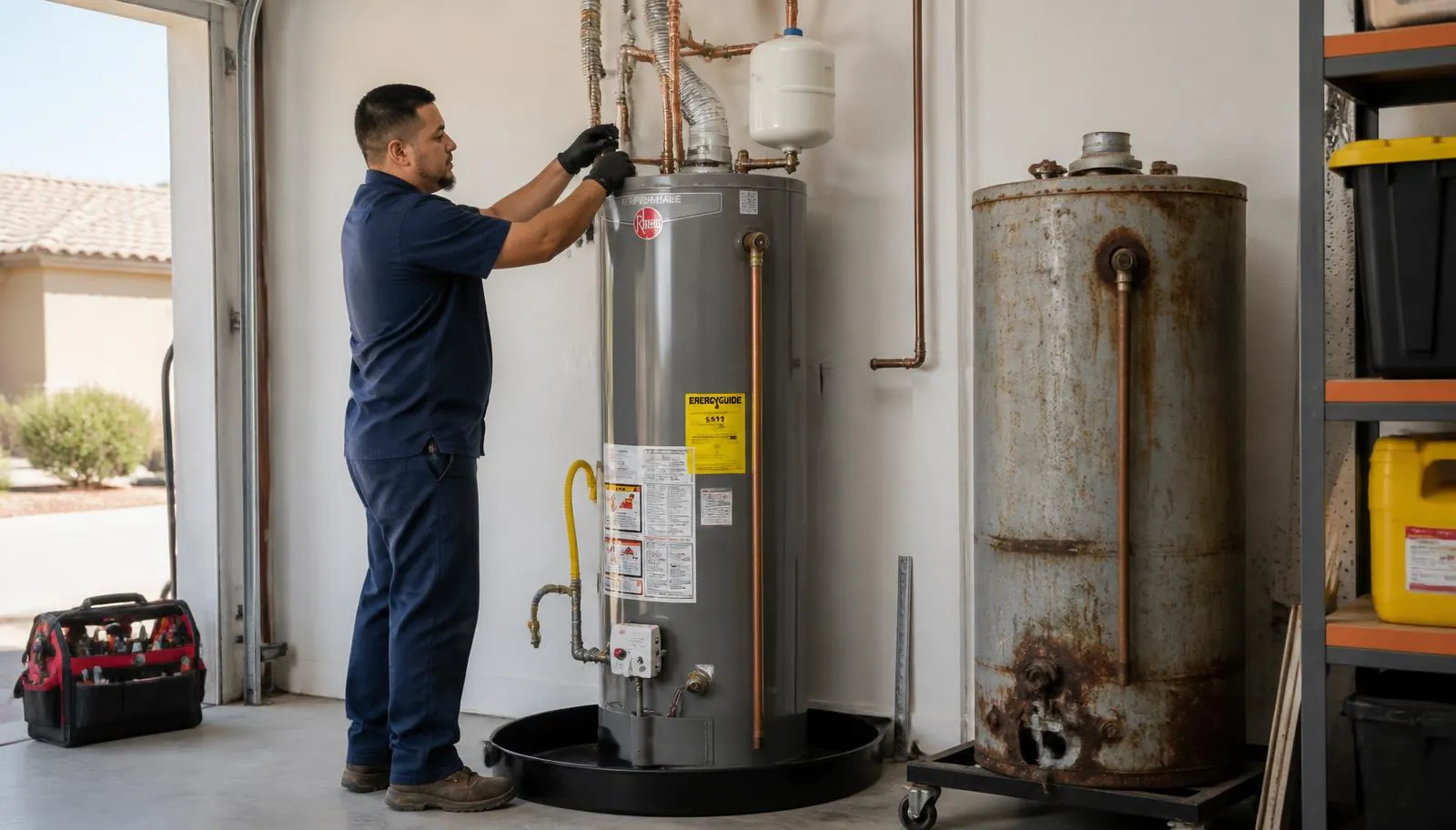
In 2026, the water heater replacement cost in Phoenix runs about $1,800 to $3,100 installed for a standard 40 or 50 gallon gas or electric tank swapped in the same spot. If the job needs code upgrades, figure $2,400 to $3,900, and a tankless conversion usually lands between $4,500 and $8,000 installed. What moves you inside those ranges is the tank size and warranty length, where the unit sits, what the old install is missing, and whether gas or electric has to be reworked.
I am Joe. My family has been fixing water heaters in the Valley since 2012, and my dad and grandpa did it before that. Three generations of plumbers, same last name on the truck. Below is how the money actually breaks down, with no hedging. You can read more about us on the Phoenix Plumbing Co. home page.
What Goes Into the Water Heater Replacement Cost in Phoenix
A price is not just a box from the supply house. The tank is maybe a third of it. The rest is labor, code parts, haul-away, the permit, and the warranty behind the work.
- Tank size and warranty class. A 40 gallon 6-year tank is cheaper up front than a 50 gallon 12-year. The 12-year has a thicker anode rod and a better liner.
- Gas or electric. Electric swaps are usually simpler. Gas adds venting, a gas flex line, and a combustion air check.
- Where it lives. Garage is easiest. Attic and interior closets take longer and need more protection.
- What the old install is missing. Expansion tank, drain pan, pan drain line, T&P discharge line, a proper shutoff, and a code-legal gas flex.
- Permit and inspection. A real permit costs money and time, and it is the right way to do it.
When a house needs most of that code list at once, that is how a $2,000 job turns into a $3,400 job. Nobody is padding it. The old install just was not up to today's rules. You can see how we handle the whole job on our water heater installation and repair page.
Tank vs Tankless: The Real Price Gap
A like-for-like tank swap is the cheapest way out the door. A tankless conversion costs two to three times more, and the reason is not the unit. It is everything the unit needs. Most Phoenix homes need a bigger gas line run, a new stainless vent through the wall or roof, a dedicated condensate path, and isolation valves for flushing.
Tankless is great if you want endless hot water and you plan to stay in the house ten years or more. It saves some gas every month, and it frees up floor space. But in our 16 to 20 grain water, a tankless has to be descaled about once a year or the heat exchanger scales up and the warranty gets shaky. Budget for that flush before you decide.
When Tankless Does Not Pay Off
If you are selling in three years, skip it. If your gas meter and line are undersized and the upgrade is a long trench, skip it. If you already get plenty of hot water from a 50 gallon tank and nobody in the house complains, the math almost never works out. I will tell you that on the phone before we ever roll a truck.
Garage, Attic, or Closet: Location Changes the Price
Garage installs are the friendliest. Open space, easy drain, short carry. That is the low end of every range above.
Attic installs are common in a lot of older Valley homes, especially in slab houses where the builder had nowhere else to put it. Expect to pay $400 to $900 more. Two guys have to get an old, wet, heavy tank down a folding ladder in July heat, then get a new one up. Attic units also need a solid pan, a working pan drain to daylight, and a platform that can hold the weight. If any of that is rotted or missing, it gets fixed on the way through.
Interior closets sit in the middle. The tank is easy to reach, but we are working over your flooring and drywall, and the door opening often forces a shorter, wider tank. Doorway too tight for a 50 gallon is a real thing, and a short tank costs a little more.
Why a 6-Year Tank Dies Early in Phoenix Water
Phoenix tap water runs about 16 to 20 grains per gallon hard. That is a lot of dissolved mineral, and when you heat it, the mineral drops out and sits on the bottom of the tank as scale. Scale insulates the burner from the water, so the steel runs hotter than it should and the anode rod gets used up faster. That is why heaters here often quit before the national average lifespan. I wrote more about that in how long a water heater lasts in Phoenix.
A builder-grade 6-year tank has a thin liner and a skinny anode rod. In 18 grain water, I see a lot of those leaking at year five or six. A 12-year tank has more anode metal and a better tank lining, and it commonly gets ten or eleven years here. The upgrade is usually $250 to $450 more. That is the easiest money you will ever spend on a water heater.
The other fix is treating the water going in. A softener slows scale in the tank, the faucets, and the dishwasher too. If you want to look at that, here is our page on water softener and filtration systems.
A Real Job Near 32nd Street and Bell
A homeowner near 32nd Street and Bell called us on a Saturday because his ceiling was dripping. Attic tank, 6-year gas unit, nine years old, rusted through the bottom. He had two quotes already, $1,950 and $3,600, and he could not figure out why they were so far apart.
Here is why. The cheap quote was tank and labor only. It did not include the new drain pan, the pan drain line that had never been run to daylight, the T&P discharge that dumped into the attic, the permit, or hauling the old tank down. The expensive one included all of it plus a tankless he did not need. We put in a 50 gallon 12-year tank, new pan and drain, proper T&P line, expansion tank, new gas flex and shutoff, pulled the permit, and hauled the old one off. It came to $3,180, and he had hot water that afternoon because the truck had everything on it.
When You Should Repair Instead of Replace
I do not replace heaters that do not need replacing. If the tank is not leaking and it is under about eight years old, a repair is often the honest answer.
- Pilot will not stay lit on a gas unit. Usually a thermocouple. A couple hundred dollars, not a couple thousand.
- Lukewarm water on an electric unit. Usually a bad upper or lower element, or a thermostat.
- Rotten egg smell or rusty water. Often a spent anode rod. Replacing the rod can add years, and in our hard water that rod is doing the heavy lifting.
- Popping and rumbling. That is scale. A drain and flush sometimes buys real time.
The line I draw is water on the floor from the tank itself. A leaking tank cannot be repaired, only replaced. If yours is actively leaking and flooding, do not wait for a callback from three companies. Our emergency plumbing crew can shut it down and get you dry.
How to Read Two Quotes and Compare Them Fairly
Most of the sticker shock I hear about comes from comparing a complete quote to an incomplete one. Before you pick, make sure both pieces of paper answer these:
- Tank size, fuel type, and warranty length in writing. 6-year and 12-year are different products.
- Is the permit included, and who pulls it?
- Are the pan, pan drain line, T&P discharge line, expansion tank, shutoff, and gas flex included, or listed as extras?
- Is haul-away of the old tank included?
- What is the labor warranty, and is it written down?
- Is the price flat and final, or an hourly estimate that can grow?
If a quote is one line and one number, ask for the breakdown. A good plumber will hand it over without getting touchy. You can also stay ahead of the whole thing with our $129 40-point plumbing inspection, which is part of our plumbing inspection and maintenance service. We check the anode, the pan, the venting, and the age plate, so a failure does not surprise you on a holiday weekend.
Get a Straight Water Heater Replacement Cost in Phoenix Today
Call 602-834-1208 and a live Phoenix dispatcher picks up, not a call center in another state. We give you upfront flat-rate pricing, so you see the price before we lift a wrench, and it does not change once we start. Every install comes with a written workmanship warranty, and our trucks carry enough stock to finish about 90% of jobs on the first visit. You can also read more about our family and our crew on the Phoenix Plumbing Co. home page. We have been doing this in the Valley since 2012, and we would rather tell you to keep your heater than sell you one you do not need.
Frequently Asked Questions
Related services
- Water Heater Repair & Installation in Phoenix, AZ
- Water Filtration & Softener Systems in Phoenix, AZ
- Plumbing Installation in Phoenix, AZ
Keep reading
Have a plumbing question this article didn't answer? Call Phoenix Plumbing Co. — a live Phoenix dispatcher picks up, and we'll give you straight advice on the phone.